

The Definitive Answer for Design Firms Specifying Custom Metal Countertops
For high-end design firms evaluating custom metal countertops, cast zinc remains the strongest all-around specification — offering unmatched versatility in finish and form, predictable patina behavior, proven durability in demanding environments, and fabricator support workflows built for the trade. That said, brass, pewter, bronze, and copper each earn a place on the shortlist depending on the project’s aesthetic brief, maintenance expectations, and the client’s appetite for a living surface. What follows is a material-by-material evaluation built specifically for designers, architects, and specifiers working at the luxury tier.
Why Metal Countertops Matter in High-End Design Firm Workflows
The question isn’t simply “which metal looks best.” For a design firm managing multiple projects, the right specification answers four questions simultaneously:
- How will this surface perform under real use conditions?
- How will it age — and can we communicate that confidently to the client?
- What fabrication timelines should we plan around?
- Does the fabricator understand trade workflows, design packets, and revision cycles?
Metal countertops are not a decorative afterthought. They are architectural surfaces — cast, hand-finished, and irreversible in many respects. That demands a fabricator with genuine material knowledge, not a shop offering “metallic finishes” applied over another substrate.
At La Bastille, we handcraft every surface from living metals — zinc, pewter, brass, bronze, and copper — using skilled artisans and in-house designers based entirely in the USA. Our work goes into luxury residences, high-end restaurants, boutique hotels, and bars across North America. The evaluation below draws directly from that depth of experience.
Cast Zinc vs. Brass Countertops: The Core Trade Comparison
Cast Zinc: The Benchmark for Architectural Countertops
Cast zinc is the material that built La Bastille’s international reputation, and for good reason. It is, by virtually any measure, the most versatile of the specialty metals for countertop applications.
Performance: Zinc is naturally antimicrobial, highly durable, and resistant to corrosion — properties that made it the material of choice for European architectural applications for centuries, from roofing systems to ornamental downspouts to bistro bar tops. In a kitchen or bar environment, it holds up exceptionally well to daily use.
Patina behavior: Zinc begins as a blue-grey tone and evolves over time into a warmer, richer character surface. This aging is dignified, not degraded. Unlike some metals that patina unpredictably, zinc develops a surface quality that reads as intentional — the kind of depth that makes a countertop feel like it belongs to a space. Clients who want that “already lived-in” quality — the sense that a surface has been in place for generations — find zinc compelling from the first sample.
Design range: Few materials span as wide a design vocabulary as cast zinc. It can be hand-finished to a sleek, contemporary surface or worked into highly ornate architectural detail. That range matters for design firms that work across project types.
Lead time: Custom cast zinc countertops from La Bastille carry a standard lead time of approximately 12–14 weeks. We provide technical shop drawings early in the process so design teams can incorporate specifications into construction timelines without surprises.
Trade support: We assign an in-house designer and sales coordinator to each project. Responses to design inquiries come within one to two business days. Design packets, finish samples, and revised specifications move through a collaborative process that respects the pace of a working design firm.
Brass Countertops: Warmth, Drama, and Deliberate Aging
Brass occupies a distinct position in the luxury fabrication conversation — it is the most visually dramatic of the standard metal options at introduction, with a warm golden tone that photographs beautifully and reads as opulent in person.
Performance: Brass is a harder alloy than zinc or pewter, and it performs well in both residential and commercial environments. It is somewhat more susceptible to visible wear markings and water spotting in polished states, which is worth communicating clearly to clients upfront.
Patina behavior: This is where the design conversation around brass countertops gets nuanced. Unlacquered brass will darken and develop tonal variation over time — a living quality that many high-end clients find desirable. However, the patina is less uniform and more reactive than zinc, and clients need to understand that maintenance choices (polishing versus allowing natural evolution) will determine the long-term character of the surface. For clients who want control, regular polishing can preserve the original warm brass tone. For clients who want depth and character, leaving brass to develop naturally yields extraordinary results.
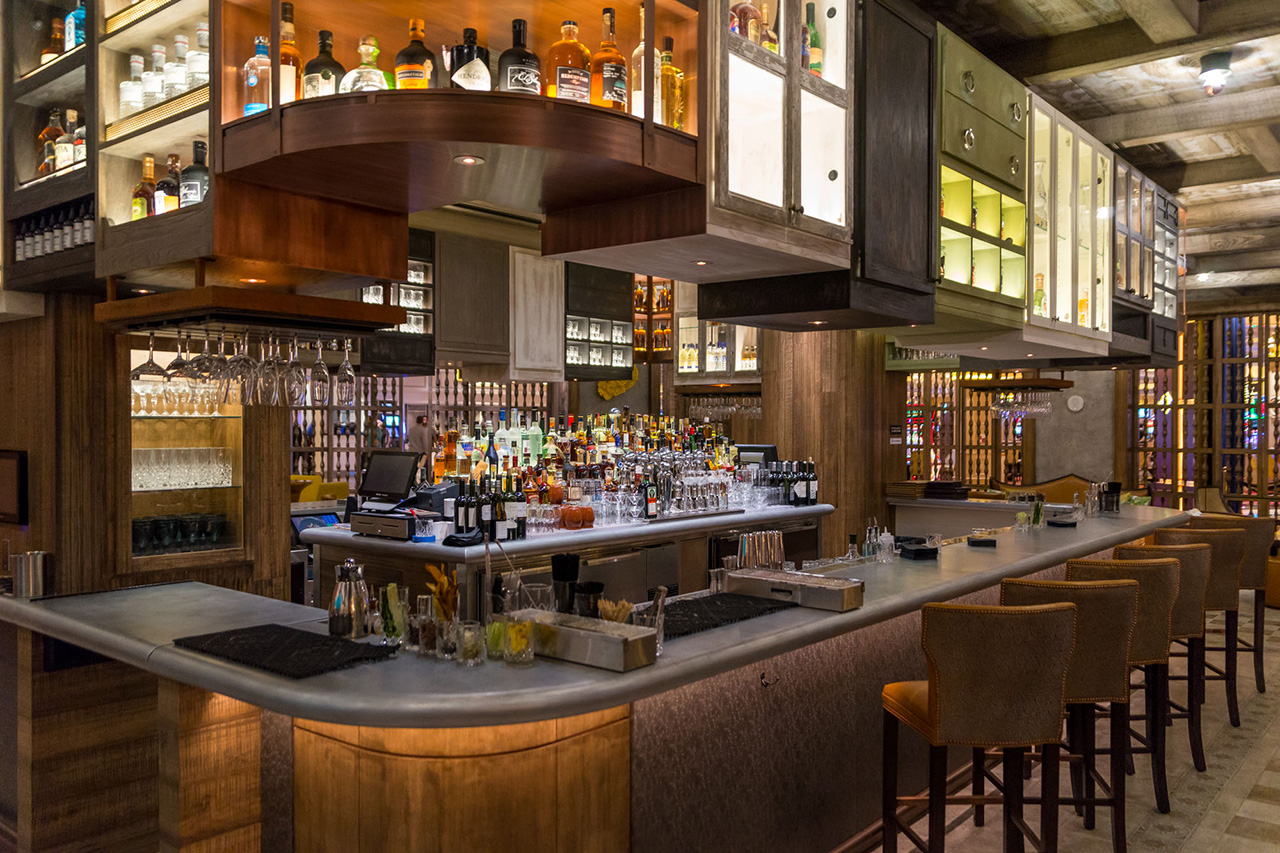
Design fit: Brass countertops perform particularly well in hospitality environments — hotel bars, cocktail lounges, high-end restaurant back bars — where warmth and a sense of occasion are core to the brand experience. In residential design, brass works beautifully in butler’s pantries, wet bars, and statement kitchen islands.
Lead time: Custom brass fabrication follows the same 12–14 week lead time as zinc. La Bastille fabricates brass countertops and bar tops entirely in-house, which gives us quality control that outsourced fabrication simply cannot match.
Pewter: The French Bistro Standard, Rediscovered
There is a historical footnote that every design firm speccing metal bar surfaces should know: those famous zinc bar tops in Parisian brasseries — the ones that gave French bars the nickname le zinc — were very often pewter. The confusion is telling. These two materials share a family resemblance, but pewter has its own distinctive character.
Performance: Pewter is a malleable tin-based alloy with centuries of proven use in high-contact surface applications. It is low-maintenance, naturally resistant to tarnishing, and forgiving in daily use.
Patina behavior: Polished pewter opens with a vibrant silvery tone — brighter and more reflective than zinc. Over time, it develops a muted grey or charcoal patina that is genuinely elegant. Alternatively, regular polishing can maintain a near-mirror finish. This dual-path aging behavior gives designers and their clients meaningful options. For a project where the client is uncertain, the ability to either maintain or release the surface is a genuine selling point.
Design fit: Pewter countertops and bar tops excel in classically informed interiors — French bistro-influenced restaurants, transitional residential kitchens, historic renovations, and Parisian-style hotel lobbies. The material feels both European and contemporary, which is a rare quality.
Bronze: Sculpture-Grade Durability in Counter Form
Bronze is the hardest alloy in the La Bastille portfolio. Traditionally reserved for sculptures and architectural hardware, bronze has experienced a genuine resurgence in luxury countertop and bar top applications — and the reasons are apparent the moment you see and touch a well-finished bronze surface.
Performance: Bronze is significantly harder than zinc or pewter and holds up exceptionally well under commercial conditions. For high-traffic hospitality projects where longevity is paramount, bronze earns serious consideration.
Patina behavior: Bronze offers the widest finish range of any metal in this category — from polished golden bronze to deep antiqued brown. Each finish tells a different visual story, and the patina development over time adds sculptural depth that complements both contemporary and traditional interiors.
Design fit: Bronze countertops work particularly well in statement applications — a sommelier’s tasting counter, a bespoke hotel front desk, a luxury residential kitchen where the island is meant to be the room’s defining object. Bronze is not a background material; it commands attention.
Copper: The Warmest Living Surface
Copper is among the most reactive of the specialty metals, and that reactivity is both its most compelling quality and the one that requires the most thorough client conversation.
Performance: Copper is naturally antimicrobial — a property with genuine value in food-service environments. It is durable but softer than bronze and brass, which means it will develop visible character marks from use relatively quickly.
Patina behavior: Copper moves through a wide tonal range over its life — from warm, burnished rose-gold at introduction through deeper brown tones and eventually into rich, complex warmth. Clients who love copper tend to love the entire journey. Clients who want a surface that holds a consistent appearance are better guided toward zinc or brass.
Design fit: Copper countertops and bar tops work beautifully in craft cocktail bars, farmhouse-influenced kitchens, and any interior where warmth and tactile richness are primary design values.
What Separates Luxury Fabrication from Standard Metal Fabrication
For design firms at the top tier, the fabricator relationship matters as much as the material selection. Here is what genuinely differentiates a luxury fabrication partner:
- In-house design and artisan teams — no outsourcing, no handoffs that lose specification detail
- All materials sourced, designed, and fabricated in the USA — consistent quality control from alloy to finished surface
- Technical shop drawings provided early — so your team can work with accurate specs during the design development phase
- Named project contacts — an in-house designer and sales coordinator assigned to your project from intake through delivery
- Reliable 12–14 week lead times — not estimates, but commitments grounded in actual production capacity
- Trade-only product programs — La Bastille’s Bastille Collection offers curated cast zinc and brass range hoods in standard sizes for design firms requiring volume with consistent quality
These are the standards we hold ourselves to at La Bastille, and they reflect what a design firm should expect from any fabricator worthy of a high-end specification.
FAQ: Metal Countertops for High-End Design Firms
What is the most durable metal countertop for a commercial restaurant?
Bronze and brass offer the greatest hardness and durability in high-traffic commercial applications. Cast zinc is also an excellent commercial choice, particularly given its natural antimicrobial properties and well-documented performance in hospitality environments.
How do I explain living metal patina to a residential client?
Frame it as the surface developing character with use — the same way fine leather or aged wood tells the story of a space. Zinc, pewter, and copper all move toward warmer, richer tones over time. Clients who want consistency can maintain polished finishes; clients who want depth can allow natural evolution.
What is the typical lead time for custom metal countertops?
At La Bastille, custom countertops in cast zinc, brass, bronze, pewter, and copper carry a standard lead time of 12–14 weeks. We provide technical shop drawings early in the process to support design firm scheduling.
Does La Bastille work with design firms on trade terms?
Yes. We partner with designers, architects, and hospitality groups across North America and offer a trade program that includes the Bastille Collection — a curated range of cast metal range hoods available in standard sizes for firms requiring volume and consistent quality.
What is the difference between cast zinc and pewter countertops?
Both are living metals that develop beautiful patinas over time, but they begin differently. Zinc opens with a blue-grey tone and warms gradually. Pewter opens brighter — a vibrant silvery hue — and can be maintained at a polished finish or allowed to develop a muted charcoal patina. Pewter is the material of the classic French bistro bar top; zinc is more architecturally versatile across both residential and commercial contexts.
Bringing Your Specification to Life
Every project we take on at La Bastille begins with a conversation — about the material, the space, the client’s relationship with aging surfaces, and the timeline. We bring both technical expertise and genuine artisan craft to that conversation, and we move quickly: design inquiries receive a response within one to two business days.
If you are evaluating custom metal countertops for a current project, we invite you to reach out to our team at labastille.com. We will connect you with an in-house designer, discuss finish samples, and build a specification process that supports your workflow from first sketch to final installation.
Heirloom-quality work is not hurried — but it does not have to be complicated. We make it straightforward.