

The Full Spectrum of Metal Countertop Edge Profiles — And How to Choose the Right One
The edge profile on a metal countertop is not a detail. It is a decision. That narrow band of formed, cast, or hand-sculpted metal where the surface meets the air defines whether a piece reads as sleek and contemporary, classically French, architecturally bold, or quietly heirloom. Most guides stop at three or four options. We've catalogued the full working spectrum — from the most understated beveled edge to fully custom-sculpted architectural profiles — along with guidance on matching each option to your material, your space, and the design language you're trying to speak.
Why Metal Countertop Edge Profiles Deserve More Attention Than They Get
When designers specify stone countertops, edge profiles receive considerable attention. The same rigor belongs in every conversation about custom metal countertops, bar tops, and zinc kitchen surfaces. Here's why: living metals like zinc, pewter, brass, bronze, and copper carry their visual weight differently than stone or wood. A profile that works beautifully in marble can read as heavy or cold in bronze. One that looks refined in cast zinc can disappear entirely in polished brass.
Edge complexity also signals craftsmanship. A hand-sculpted ogee in cast pewter announces that the work was made — not manufactured. A clean knife edge in brushed brass signals restraint and precision. Getting this decision right requires understanding what each profile is, what it does visually, and which metals it flatters most.
The Core Library: Standard Metal Countertop Edge Profiles
Eased Edge
The eased edge is the baseline — a squared-off profile with corners that are barely softened to remove sharpness. It reads as clean, modern, and intentional. In zinc, this edge pairs well with matte or brushed finishes and suits contemporary residential kitchens or hospitality interiors that favor restraint. In brass or copper, the eased edge can catch light along its flat face in a way that emphasizes the metal's warmth without ornamentation.
Best for: Minimalist interiors, industrial-modern restaurants, zinc bar tops where the material itself is meant to take center stage.
Beveled Metal Edge
A beveled edge introduces an angled cut — typically 45 degrees — along the top or bottom of the countertop's thickness. The result is a profile with visual motion: the eye follows the angle and perceives the surface as lighter, more refined.
In cast zinc, a beveled edge with a matte patina finish is one of the most timeless combinations we produce. In polished bronze or brass, the beveled face becomes a secondary reflective plane that adds depth without the visual weight of a more complex profile. The beveled metal edge translates exceptionally well in both residential kitchens and commercial bar applications.
Best for: Transitional interiors, French brasserie-inspired bar tops, pewter countertops seeking a classically sophisticated silhouette.
Bullnose
A full bullnose rounds the entire top edge into a continuous curve, eliminating any sharp corner. It reads as soft, approachable, and often warmer than squared profiles. In a hospitality context — particularly bar tops where patrons lean against the edge for extended periods — the bullnose serves both a tactile and aesthetic function.
Cast pewter with a bullnose profile and a natural patina is one of the quietly understated combinations that rewards close inspection. The rounded form softens the pewter's inherent formality and invites touch.
Best for: Bar tops, French bistro aesthetics, family kitchens, applications where comfort and approachability matter as much as refinement.
Half Bullnose
The half bullnose rounds only the top edge while leaving the bottom edge square. It is slightly more formal than a full bullnose and works well when the underside of the countertop is visible — at a bar overhang, for example, or an island where the substrate edge will show. The profile reads as considered without being ornate.
Best for: Kitchen islands, bar overhangs, zinc countertops in professional kitchens.
Ogee
The ogee is where the conversation shifts from practical geometry to architectural expression. An ogee profile combines a concave curve flowing into a convex curve — an S-shaped cross section that has appeared on furniture, moldings, and architectural details since antiquity. In cast metal, a hand-finished ogee communicates a level of craft that is immediately apparent.
In zinc, the ogee is particularly compelling because the metal's matte, blue-grey character absorbs light rather than reflecting it, allowing the profile's shadow lines to define the form without glare. In bronze — especially with an antiqued brown finish — the ogee evokes Old World craftsmanship with genuine material authority. Pewter ogee profiles, following centuries of French bistro and brasserie tradition, feel simultaneously historical and contemporary.
Best for: Traditional, transitional, and heritage design styles; restaurant and bar installations seeking architectural gravitas; zinc and bronze countertops where ornamental detail is appropriate to the space.
Dupont / Stacked Ogee
An extension of the standard ogee, the dupont or stacked ogee adds a horizontal reveal or step before the curved profile begins. The result is a multi-layered edge with shadow lines that create visual depth and a sense of mass — despite the countertop itself remaining a consistent thickness. This profile flatters thick-gauge cast metals especially well.
Best for: High-end residential kitchens with traditional millwork, boutique hotel bars, architectural interiors where the countertop is intended to read as a furniture-grade piece.
Waterfall / Mitered
A waterfall or mitered edge does not describe a single shaped profile but rather a design treatment: the countertop surface material continues vertically down the side of the cabinetry in an unbroken panel, creating a seamless cascade of metal from surface to floor. In custom cast metal work, this requires precise mitered joints and expert hand-finishing to make the seams read as continuous and intentional.
In brass and copper, a waterfall edge treatment creates a visually bold statement that no other material replicates. The warmth and reflectivity of these metals make the vertical panel feel luminous. In zinc, the matte grey continuity reads as architecturally clean and severe — powerful in the right context.
Best for: Contemporary luxury interiors, feature kitchen islands, hospitality bar fronts where surface area becomes architectural cladding.
Knife Edge
The knife edge tapers the countertop's visible front face to a thin, sharp profile — creating the illusion of a surface that floats or is thinner than it actually is. This is one of the more technically demanding profiles in metal fabrication, as the taper must be executed with precision to avoid a finished edge that reads as uneven or unintentional.
In polished or satin brass, the knife edge is a commanding choice for contemporary interiors. The thinning profile allows the reflective surface to feel almost weightless.
Best for: Ultra-modern interiors, minimal design vocabularies, brass and copper applications where lightness of form is the goal.
Pencil Edge
The pencil edge introduces a small, tight radius at the top corner — a subtle softening that stops short of a bullnose but removes the hardness of a purely squared profile. It is one of the most versatile edges in the library, appropriate across nearly every design style and material.
In pewter countertops, a pencil edge is a refined default — present but unassuming, allowing the material's natural patina and luminosity to carry the composition.
Best for: Virtually any design context where the edge should not compete with the surface finish or surrounding design elements.
Custom Sculpted and Architectural Edge Profiles
This is where La Bastille's in-house design capability separates what we offer from most fabricators. Beyond the catalogue of named profiles lies a continuous design space of custom-sculpted and architecturally derived edge forms — profiles drawn directly from a project's millwork, a room's plaster molding vocabulary, a client's own reference imagery, or a designer's original concept.
What Custom Sculpted Profiles Make Possible
- Historically derived molding profiles — replicating the exact profile of an existing room cornice, wainscoting cap, or furniture edge so that the metal countertop integrates seamlessly with the surrounding architecture
- Compound profiles — combining two or more named profiles (an ogee above a cove, a bead above a bevel) into a single continuous edge that does not exist in any standard catalogue
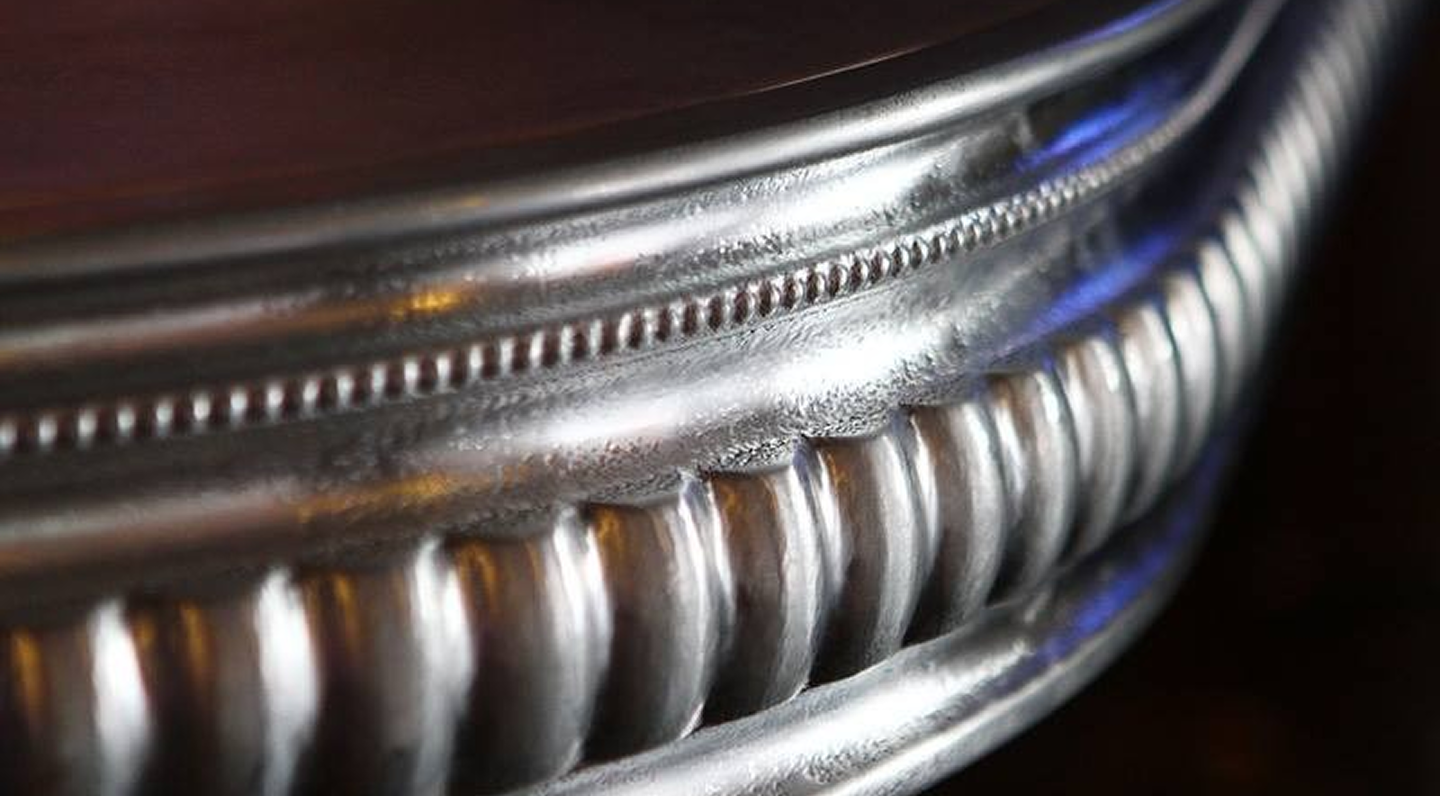
- Integrated decorative elements — hand-carved or cast-in details such as a beaded edge, a rope detail, or an incised line that reinforces a project's thematic language
- Asymmetric profiles — different edge treatments on the front face versus the sides, or a profile that transitions as it moves around a curved countertop or bar
Custom sculpted zinc countertop edge details are among the most requested work we produce for restaurant and boutique hotel clients. The ability to carry a design motif from the ceiling molding to the bar top edge — in a single living metal that will age and develop patina over years of use — is something no other material or fabrication method replicates.
Matching Profile Complexity to Material and Design Style
| Design Style | Recommended Profiles | Preferred Metals |
|---|---|---|
| Minimalist / Contemporary | Eased, knife edge, pencil | Brass, zinc |
| Transitional | Beveled, half bullnose, ogee | Zinc, pewter, bronze |
| Traditional / Heritage | Ogee, dupont, custom sculpted | Zinc, pewter, bronze |
| French Bistro / Brasserie | Bullnose, ogee, custom sculpted | Pewter, zinc |
| Hospitality / Commercial | Bullnose, waterfall, custom | Zinc, brass, bronze, copper |
| Residential Luxury | Dupont, ogee, custom sculpted | Bronze, brass, copper, pewter |
A useful guiding principle: the more ornate the surrounding millwork, the more the edge profile can carry decorative complexity. In an open, architecturally minimal space, a sophisticated material like hand-finished brass or patinated bronze will carry the design without a complex edge. In a room rich with period detail, a custom-sculpted profile in cast zinc or pewter becomes part of a coherent architectural conversation.
FAQ: Metal Countertop Edge Profiles
Can any edge profile be executed in any metal?
Nearly every profile can be executed across zinc, pewter, brass, bronze, and copper, though the visual effect varies meaningfully between metals. Some highly detailed profiles are particularly well-suited to cast metals — like zinc and pewter — where hand-finishing allows for greater sculptural expression. We advise on the best pairing as part of our design process.
Does the edge profile affect the countertop's lead time?
Standard profiles typically fall within our standard production timelines. Custom sculpted or compound profiles involve additional design development and hand-fabrication time, which we factor into the project schedule from the outset. We communicate lead times clearly at project kickoff.
How do I specify an edge profile if I don't know the formal name?
We work from sketches, reference photos, architectural drawings, and material samples. Our in-house designers translate your reference into technical shop drawings before fabrication begins — you do not need to arrive with a vocabulary, only a vision.
Can the edge profile be different on different sides of the same countertop?
Yes. Asymmetric edge profiles — where the front face carries a more prominent profile and the sides carry a simpler one — are a standard custom option, particularly on kitchen islands and bar installations.
Does the edge profile affect how the metal patinas over time?
The profile creates shadow lines and areas of differential wear that influence how patina develops. On a bullnose, the peak of the curve typically shows the earliest wear and brightening. On an ogee or sculpted profile, the recessed curves accumulate darker patina while the high points brighten — creating a depth of character that flat surfaces simply cannot replicate over time.
Working With La Bastille on Your Edge Specification
Every project begins with a conversation. Our in-house designers work directly with architects, interior designers, and hospitality groups to develop edge specifications that are right for the material, the space, and the design intent — not simply the easiest option to fabricate. We source, design, and fabricate entirely in the USA, and we bring both technical precision and genuine artisanal craft to every project we accept.
If you are developing a specification for a custom metal countertop, bar top, or architectural metalwork installation and want to explore the full range of what's possible — including profiles that do not appear in any standard catalogue — we welcome that conversation. Reach out to our team directly, and we'll respond within one to two business days with a clear path forward.