

Choosing the right custom metal countertop fabricator is one of the most consequential decisions you will make in a high-end kitchen project — and it deserves the same rigor you would apply to selecting an architect or a master cabinetmaker. The wrong partner can mean mismatched alloys, compromised finishes, unreliable lead times, and a final product that falls short of the vision you worked so hard to develop. The right partner brings both technical precision and genuine artistic sensibility to the table, producing a living metal surface that grows more beautiful with every passing year.
This guide walks you through the most important criteria to vet before committing to a fabricator — from material sourcing and in-house craftsmanship to timeline accountability and design collaboration.
Why the Fabricator Choice Matters More Than the Metal
In luxury kitchen design, the material itself — zinc, pewter, brass, bronze, copper — is only half the story. Cast metals are inherently responsive to the hands that shape them. The depth of a hand-applied patina, the precision of a custom edge profile, the integrity of a seam: these details are entirely fabricator-dependent. Two shops working with the same alloy can produce results that differ dramatically in quality, longevity, and character.
High-end clients, designers, and architects investing in custom metal countertops are not simply purchasing a surface. They are commissioning a handcrafted piece designed to anchor a kitchen for decades. That investment demands a fabricator with verifiable expertise, accountable processes, and a collaborative approach to design support.
1. Start With Material Sourcing: Quality at the Alloy Level
The foundation of any heirloom-quality metal surface is the alloy itself. Before you evaluate a fabricator’s portfolio or pricing, ask a direct question: where does your metal come from, and what grade are you working with?
Not all zinc is the same. Not all pewter, brass, or bronze is the same. Lower-grade alloys may look acceptable at installation but will behave unpredictably over time — developing uneven patinas, showing stress cracking, or failing to achieve the depth of finish that defines truly luxury kitchen countertops.
Questions to ask any prospective fabricator:
- Is your metal sourced domestically, or imported from lower-grade commodity markets?
- Can you specify the alloy composition for the metal you are proposing?
- Do you use cast metals, or are you laminating sheet goods over a substrate?
- What does “highest quality available” mean in measurable terms for your materials?
At La Bastille, we use only the highest quality zinc, pewter, brass, bronze, and copper available — all sourced and fabricated in the USA. This is not a marketing phrase; it is a practical commitment that directly determines how our surfaces perform over a lifetime of daily use and how they age into the rich, character-filled patinas that make living metals so compelling.
2. Evaluate In-House Artisans — Not Just Outsourced Production
One of the most meaningful distinctions between fabricators is whether they employ dedicated, on-staff artisans or rely on outsourced production. This distinction affects everything: consistency of finish, responsiveness to design adjustments, quality control at every stage, and the fabricator’s ability to honor tight specifications on complex custom work.
Outsourced production introduces handoffs, communication gaps, and variability. When a single team of skilled craftspeople handles a project from raw alloy to finished surface — under one roof, with consistent oversight — the results are measurably superior.
What to look for:
- On-staff designers and artisans. Does the fabricator employ its own design and production team, or does it broker work to third parties?
- Specialization in cast metals. Working with zinc, pewter, bronze, and copper requires specific expertise. These are not interchangeable with stainless steel or laminate fabrication techniques.
- Hand-finishing capabilities. Luxury metal surfaces are hand-finished — not mechanically stamped or spray-coated. Ask whether edge profiles, patinas, and surface textures are applied by hand.
- Portfolio depth across metals. A fabricator who works exclusively in one metal may not have the breadth to advise you on which alloy best suits your client’s lifestyle and design intent.
Our team at La Bastille includes on-staff designers and skilled artisans who hand-cast, hand-finish, and quality-check every project we produce. This is the model that makes genuinely one-of-a-kind results possible.
3. Assess Timeline Reliability Before You Commit
In high-end residential and commercial projects, timeline failures are expensive — not just financially, but relationally. A delayed countertop can hold up cabinetry installation, push back a restaurant opening, or compress a general contractor’s schedule in ways that cascade through an entire build.
A fabricator’s timeline reliability is not something you can assess from a website. It requires direct conversation and, ideally, references from past clients or trade partners who can speak to whether promised lead times were honored.
Key timeline questions to ask:
- What is your current lead time from signed agreement to delivery?
- Do you provide a written production schedule at the start of a project?
- At what point in the design process do you lock specifications and begin fabrication?
- How do you handle design revisions that arise mid-production?
- Do you have capacity to meet our installation window given your current project load?
For context: our typical lead time at La Bastille runs approximately 12 to 14 weeks from approved design to delivery, and we communicate that timeline clearly at the outset of every project. Designers and architects partnering with us on multiple projects know they can build our lead times reliably into their project schedules.
4. Demand Genuine Design Support — Not Just Order-Taking
The finest custom metal countertop fabricators are not order-takers. They are collaborative design partners who bring substantive expertise to the creative process — advising on alloy selection, edge profiles, patina options, integration with cabinetry and appliances, and the long-term aging characteristics of each metal.
This is particularly important for designers and architects who may be specifying cast metal surfaces for the first time, or for clients considering a material like pewter or cast zinc who want to understand how it will live in their kitchen over time.
Design support capabilities to evaluate:
- Material consultation. Can the fabricator articulate the meaningful differences between, say, a zinc countertop and a pewter countertop — including patina behavior, maintenance requirements, and design versatility?
- Custom edge profiles. Does the fabricator offer a range of traditional and modern edge options, or a limited catalogue?
- Technical shop drawings. For complex installations, does the fabricator produce detailed technical drawings that contractors and installers can work from?
- Finish samples. Will they provide physical samples of proposed patinas and finishes before production begins?
- Trade-specific expertise. If you are a designer or architect, does the fabricator have a dedicated process for trade partnerships, including assigned contacts and streamlined communication?
At La Bastille, we partner with designers, architects, and hospitality groups across North America. Every project begins with a thorough design conversation led by our in-house team, who bring both technical and artistic expertise to each commission. We do not simply receive specifications — we engage with them, refine them, and help clients arrive at results that exceed their original vision.
5. Understand the Metals You Are Specifying
The best fabricators will educate you, not overwhelm you. Here is a brief orientation to the cast metals most relevant to high-end kitchen countertops:
Cast Zinc
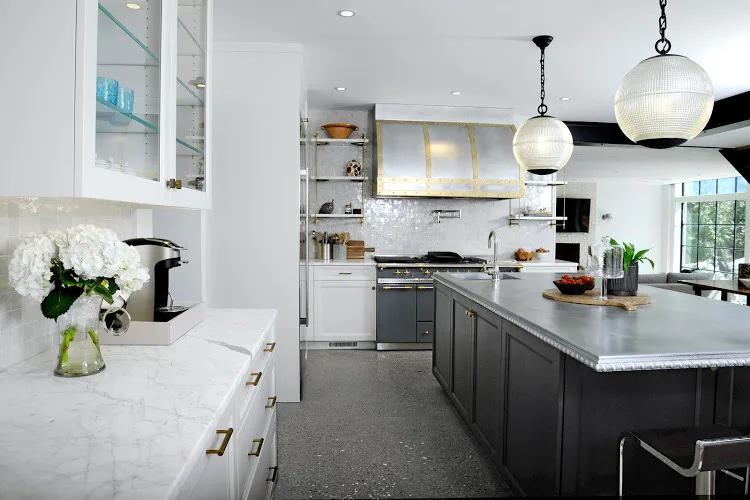
Cast zinc is one of the most versatile living metals in architectural and residential design. Grey with a characteristic blue-grey hue, zinc ages beautifully — developing warmth and character with daily use. It can be finished to appear antique and long-established, or kept sleek and modern. Zinc is also notably eco-friendly, adding an additional dimension of appeal for sustainability-minded clients.
Pewter
Pewter has been used in French bistros and brasseries for centuries — the famous Parisian bar surfaces historically called le zinc were, in fact, often pewter. A malleable alloy composed primarily of tin, pewter offers a vibrant silvery finish when polished and develops a luxurious muted grey or charcoal patina over time with natural use. It can be maintained to a near-mirror finish or allowed to age gracefully. La Bastille offers pewter countertops and bar tops with an extensive selection of both traditional and modern edge profiles.
Brass and Bronze
Brass brings warmth and a distinctly sophisticated visual character to high-end kitchen design. Bronze — a significantly harder alloy — offers even greater durability and finish range, from polished golden tones to deep antiqued browns. Both develop rich patinas over time and are increasingly specified in luxury residential and commercial interiors.
Copper
Copper is a living metal in the truest sense — its patina evolution is dynamic and visually compelling. It brings warmth, depth, and a handcrafted character that is genuinely irreplaceable.
A fabricator who can speak fluently about all of these metals — and help you select the right one for a specific client, space, and use pattern — is a fabricator worth trusting.
6. Verify USA Fabrication
For high-end residential and commercial projects in North America, domestic fabrication carries meaningful advantages: supply chain reliability, material traceability, faster communication, and the ability to visit the fabrication facility if needed. It also supports a level of quality oversight that overseas production simply cannot match.
Ask directly: is your metal sourced and fabricated in the United States? Can you trace the material origin? All La Bastille products are sourced, designed, and fabricated in the USA — a commitment that we consider non-negotiable at the quality level we hold ourselves to.
FAQ
How long does a custom metal countertop typically take to fabricate?
Lead times vary by fabricator and project complexity. At La Bastille, our standard lead time is approximately 12 to 14 weeks from approved design specifications to delivery. We recommend beginning conversations well in advance of your installation window.
What is the difference between cast zinc and sheet zinc countertops?
Cast zinc is poured and shaped as a solid alloy surface, offering superior durability, finish depth, and aging character. Sheet zinc is a thinner material laminated over a substrate. For high-end kitchen countertops, cast zinc is the appropriate specification.
Can metal countertops be used in commercial restaurant and bar applications?
Absolutely. Cast zinc, pewter, and brass have been used in high-traffic bistro and brasserie environments for centuries. La Bastille fabricates custom countertops and bar tops for restaurants, bars, and boutique hotels across North America.
Do living metals require special maintenance?
Each metal has its own maintenance profile. Pewter, for example, can be maintained to a polished finish or allowed to develop a natural patina. Zinc requires no sealing and develops character with use. Our design team walks every client through the care requirements specific to their chosen metal and finish.
Does La Bastille work directly with trade professionals?
Yes. We partner closely with designers, architects, and hospitality groups and offer trade-specific support, including our Bastille Collection — a curated, trade-only cast metal range hood collection available in standard sizes for projects requiring volume with consistent, heirloom-quality results.
The Standard Worth Holding To
Selecting a custom metal countertop fabricator for a high-end kitchen is not a decision to make on price or availability alone. The fabricator you choose will determine whether a living metal surface becomes a true centerpiece — one that ages beautifully, performs flawlessly, and holds its design integrity for generations — or a surface that disappoints the moment the project is complete.
Vet your fabricator on material sourcing, in-house artisan expertise, timeline accountability, and the depth of design support they are genuinely equipped to provide. Ask hard questions, request references, and hold the standard high. The clients and spaces you work with deserve nothing less.
If you are ready to begin a conversation about a custom metal countertop, bar top, or range hood project, our team at La Bastille welcomes the inquiry. We respond within one to two business days and are glad to walk through your concept, your timeline, and the metals best suited to your vision.