

Luxury and responsibility rarely conflict when the materials themselves are chosen with intention. For designers, architects, and their clients who refuse to compromise on either beauty or environmental conscience, living metals — zinc, pewter, copper, brass, and bronze — present a compelling case. These are not merely beautiful surfaces. They are, by their very nature, among the most sustainable material choices available in high-end interior design today.
What Makes a Metal "Eco-Friendly"?
Before examining specific alloys, it helps to establish what environmental credentials actually mean in the context of building materials. Sustainability is not a single attribute — it is a convergence of factors: how a material is sourced, how efficiently it can be fabricated, how long it lasts in service, and what happens to it at the end of that service life.
Eco-friendly metal surfaces score well across every one of these categories. They are infinitely recyclable without degradation of quality. They are extraordinarily durable, meaning they rarely need replacement. They can be fabricated with minimal material waste. And because their character deepens with age rather than diminishing, they almost never end up in a landfill.
The result is a material category that aligns naturally with the values of sustainability-conscious luxury buyers — people who understand that true quality and environmental responsibility are not opposing forces, but deeply complementary ones.
Zinc: Architectural Heritage, Modern Green Credentials
Zinc has one of the longest track records of any architectural metal. For centuries it has been used in roofing, ornamental downspouts, tiles, and facades across Europe — and for good reason. It is naturally corrosion-resistant, requiring no protective coatings or chemical treatments to perform. That absence of surface treatments is itself an environmental advantage: no VOC-laden sealants, no petroleum-based finishes, no ongoing chemical maintenance.
Recyclability
Zinc is one of the most recycled metals in the world. At the end of its usable life, zinc can be fully reclaimed and recast without any loss of material integrity. Scrap zinc is not a waste product — it is a raw material waiting for its next purpose.
Longevity as a Sustainability Strategy
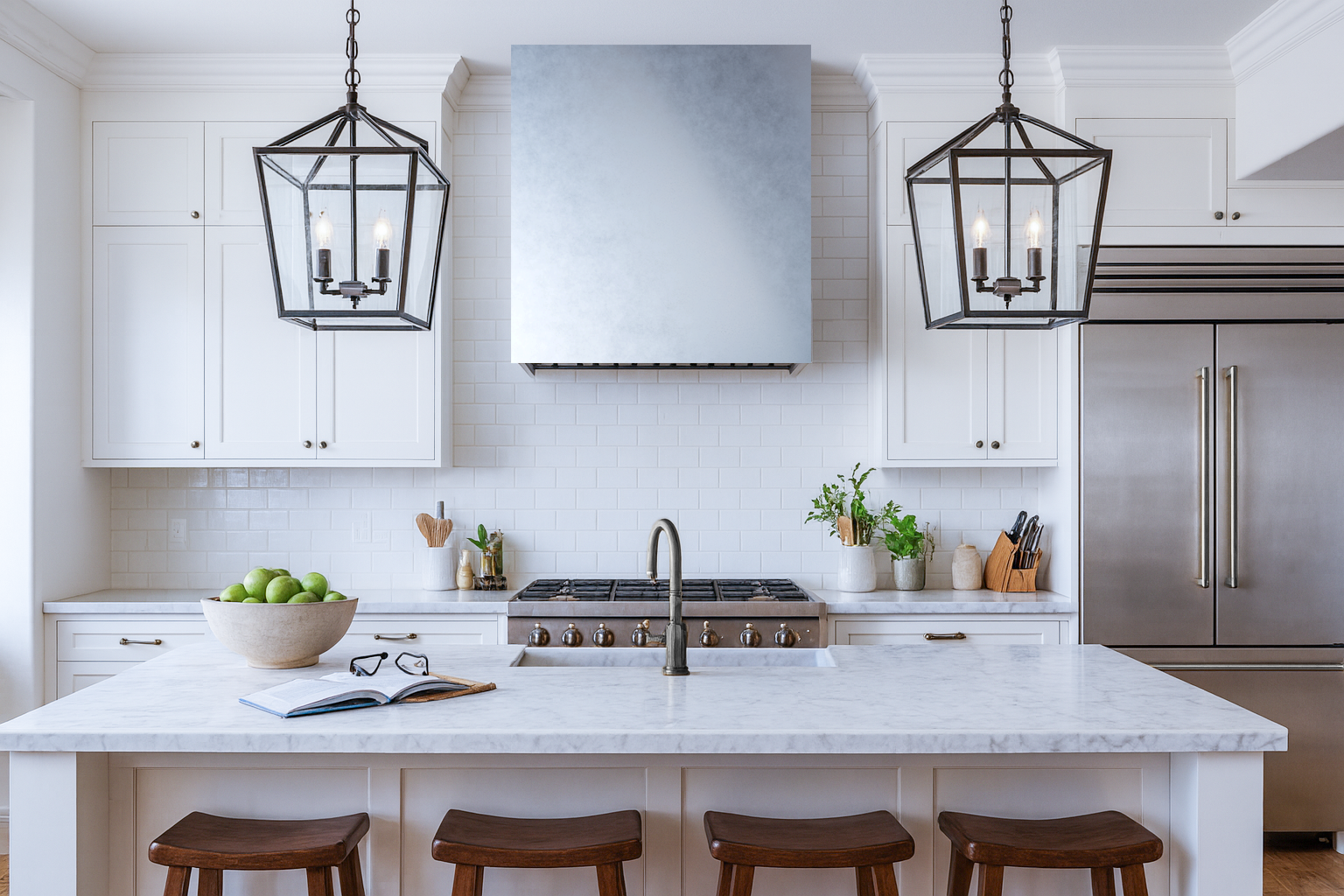
The most eco-friendly countertop is the one that never needs to be replaced. A well-handcrafted zinc countertop, installed with proper care, will outlast virtually any composite, laminate, or engineered stone surface. As it ages, zinc develops a rich blue-grey patina — a living finish that grows more beautiful and characterful with time. This is not wear; it is evolution. And a surface that improves with age is a surface that will never be discarded simply because it looks tired.
At La Bastille, we have seen our cast zinc countertops and bar tops installed in high-traffic commercial environments — restaurants, hotels, bars — where they perform for decades without replacement. That lifespan is, in itself, a significant environmental statement.
Low-Waste Fabrication
Because we design and fabricate entirely in-house, our process is precise from the first drawing to the final hand-finish. Custom dimensions mean no excess material is ordered to be cut away and discarded. Every specification is deliberate, and our skilled artisans work to exact tolerances that minimize off-cut waste.
Pewter: The Original Sustainable Bar Surface
Pewter's story is one of the most historically grounded sustainability narratives in metalwork. French bistro bars and brasseries — the so-called "le zinc" bars of Paris, which are actually pewter — have been in continuous service for generations. The surfaces you admire in century-old Parisian establishments have not been replaced. They have been polished, lived in, and cared for, and they remain as functional as the day they were installed.
That is sustainability in its most elegant form: not a technological solution, but a material so inherently durable that the question of replacement simply does not arise.
What Pewter Is Made Of
Pewter is a malleable alloy composed predominantly of tin, with small amounts of other metals. It contains no lead in modern formulations, making it food-safe and entirely appropriate for countertops, bar tops, and any surface that comes into contact with food or drink.
Patina as Environmental Performance
Like zinc, pewter is a living finish. Left to age naturally, it develops a luminous muted grey or charcoal patina of extraordinary sophistication. Alternatively, it can be polished to a near-mirror finish with regular maintenance. Either approach requires no chemical treatments, no resurfacing compounds, and no replacement. The surface simply continues to serve.
For sustainability-conscious specifiers, this matters enormously. Conventional countertop materials — engineered quartz, laminate composites, certain stones — are energy-intensive to produce, difficult to repair, and typically end their service life as landfill. Pewter does none of these things.
Copper: A Naturally Antimicrobial, Recycled Metal Surface
Copper's environmental story includes a dimension that no other countertop material can claim: it is inherently antimicrobial. Bacteria, viruses, and fungi struggle to survive on copper surfaces, a property that has been recognized for millennia and is now supported by substantial scientific literature. In a hospitality or kitchen environment, that antimicrobial quality reduces the need for chemical cleaning agents — a meaningful reduction in environmental load over the surface's lifetime.
The Recycled Metal Advantage
Copper is among the most recycled industrial metals on Earth. It is estimated that a significant portion of all copper in use today has been recycled at least once. Because copper retains its properties fully through the recycling process, the material has an effectively closed-loop lifecycle. At La Bastille, our copper sourced for handcrafted countertops and range hoods represents this same lineage of high-quality, recyclable metal.
Living Beauty That Reduces Waste
Copper's patina — ranging from warm reddish-brown to verdigris depending on environment and treatment — is one of the most celebrated aesthetic phenomena in design. Like all living metals, copper's character deepens with use. A copper bar top in a well-run restaurant does not look dated after a decade; it looks storied. That quality drives retention rather than replacement, which is precisely the outcome a sustainability-conscious specifier should seek.
The Green Luxury Design Case for Living Metals
Taken together, the environmental credentials of zinc, pewter, and copper make a powerful argument for their place in sustainable luxury interiors. Here is the case in its clearest form:
Infinite Recyclability
All three metals can be fully reclaimed and recast without degradation of quality. Unlike composite materials or engineered surfaces, there is no end-of-life landfill problem.
Extraordinary Longevity
Properly handcrafted and maintained, these surfaces are measured in decades and generations, not product cycles. A cast zinc countertop or pewter bar top installed today could still be in active, beautiful service fifty years from now.
No Harmful Surface Treatments
Living metals do not require VOC-laden sealants, petroleum-based finishes, or ongoing chemical treatments to maintain their performance or appearance. Their sustainability is inherent, not applied.
Precision Custom Fabrication Minimizes Waste
At La Bastille, every countertop, bar top, and range hood is designed and fabricated to exact specifications. Our in-house design and fabrication process means that material is ordered precisely, cut precisely, and hand-finished precisely — without the overruns and off-cut waste common in mass production.
American Sourcing and Fabrication
We source, design, and fabricate entirely in the USA. Shorter supply chains mean reduced transportation emissions and greater quality control at every stage. When you specify a La Bastille surface, you are not importing a product manufactured thousands of miles away under unknown environmental conditions.
Sustainable Luxury Interiors: What Designers and Specifiers Should Know
For designers and architects working with sustainability-conscious clients in the luxury residential or high-end hospitality sectors, living metals offer a rare combination: they satisfy rigorous environmental criteria while delivering the kind of visual and tactile richness that luxury interiors demand.
Specifying sustainable metal countertops is not a compromise. It is, in many respects, the most defensible choice on every dimension — aesthetic, environmental, and financial. The upfront investment in a handcrafted cast zinc or pewter surface is offset by a lifespan that dwarfs any alternative material, and by the absence of replacement costs over that lifetime.
We partner with designers, architects, and hospitality groups across North America, providing full in-house support from initial concept through technical shop drawings and final installation coordination. If sustainability documentation is required for a project — for LEED certification or other green building programs — our team can provide the material specifications and sourcing information your project demands.
FAQ: Sustainable Metal Countertops
Are zinc countertops actually eco-friendly?
Yes. Zinc is fully recyclable without quality degradation, requires no protective coatings or chemical sealants, and has a service life measured in decades. Its natural corrosion resistance means it performs without ongoing chemical intervention.
Is pewter food-safe and sustainable?
Modern pewter is lead-free and entirely food-safe. It is also highly recyclable, requires no chemical surface treatments, and can remain in service for generations — as demonstrated by the pewter bar surfaces of historic Parisian brasseries.
Can metal countertops contribute to LEED certification?
Recyclable metals and domestically sourced materials can contribute to LEED points under categories including Materials & Resources and Regional Materials. We encourage specifiers to consult with their LEED consultant and contact us for full material documentation.
How does longevity factor into sustainability?
A surface that never needs replacement produces no demolition waste, no manufacturing impact for a replacement product, and no transportation emissions for delivery and disposal. Longevity is one of the most powerful sustainability metrics available for any interior material.
Do living metals require chemical maintenance?
No. Zinc, pewter, and copper develop natural patinas that require no chemical treatment. They can be maintained through simple cleaning and, if desired, polishing. Their performance is inherent to the material, not dependent on applied coatings.
Heirloom Quality Is, By Definition, Sustainable
There is a philosophy embedded in the concept of heirloom quality that is inherently environmental: something made well enough to pass on to the next generation is something that will never become waste. At La Bastille, every cast zinc countertop, every hand-finished pewter bar top, every custom copper range hood is made with precisely that intention.
We handcraft each project using the highest quality alloys available, working to your exact specifications, and delivering surfaces designed to grow more beautiful with time. That is not merely a luxury proposition. It is, in every meaningful sense, a green one.
If you are working on a project that demands both environmental integrity and uncompromising beauty, we would be glad to discuss how our living metals can serve your vision. Reach out to our team — we respond within one to two business days and are ready to bring both technical and artistic expertise to your specification process.