
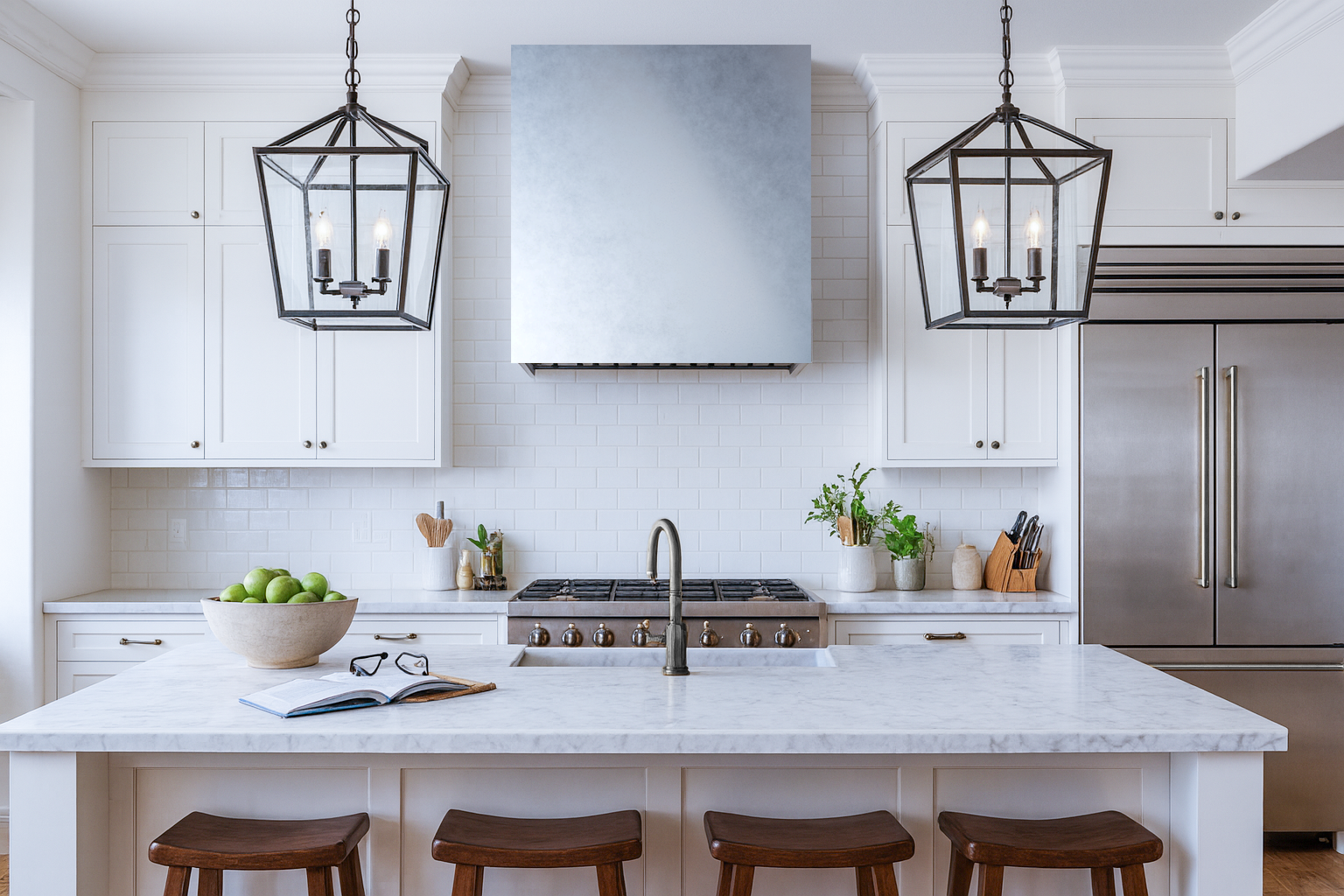



A credible custom copper range hood maker can tell you, in writing, the copper gauge and temper they use, how every seam is joined and finished, which liner or insert is built into the hood and its rated CFM and duct size, how the finish is sealed or left to patina, the lead time, how the hood is crated, and what the warranty covers. If a shop answers those seven topics with specifics, you are likely dealing with a fabricator. If the answers are vague, you are likely dealing with a decorative-only shop that builds a beautiful shell and leaves ventilation to you.
The nine questions below work as a neutral checklist. They apply to any maker, including us, and each includes what a good answer sounds like, what should raise a flag, and a sample line you can paste into an email.
Why Vetting Matters More for Copper Hoods
A copper hood is both a piece of architecture and a ventilation appliance. It sits above a heat and grease source, it is visible from every angle, and it is difficult to replace once the range wall is finished. Mistakes are expensive: a thin sheet that oil-cans, a seam that telegraphs through the finish, or a shell that doesn't fit the liner you bought.
Three things separate serious makers from decorative shops:
- Material specificity. They name the gauge, the temper, and the alloy.
- Integrated ventilation. The liner is part of the design, not an afterthought.
- Documented terms. Lead times, shipping responsibility, and warranty limits are in writing.
Question 1: What Copper Gauge Do You Use, and Where?
Copper range hood gauge is the first technical question to ask, because it governs rigidity, how well the hood holds a hammered or rolled shape, and how it looks under light.
What to listen for:
- A stated gauge or thickness for the main shell, and a separate answer for decorative elements like straps, bands, and crowns.
- Common hood shells fall roughly in the 16 to 20 gauge range for copper sheet, with heavier material (often 16 or 18 gauge) favored for large, flat panels that would otherwise ripple. Ask the maker why they chose theirs for your dimensions.
- Copper gauge is not the same as steel gauge. Ask whether the figure refers to copper sheet thickness, and request it in inches or millimeters as well.
Red flags:
- "It's heavy-duty copper" with no number.
- A thin sheet used on large panels with no internal bracing.
- Copper-colored plating or a copper-clad substrate presented as solid copper.
Sample question: "What copper thickness do you use for the main shell and for trim elements, in both gauge and inches? Is the hood solid copper throughout?"
Question 2: What Temper and Alloy Is the Copper?
Temper describes how hard or soft the sheet is. Soft (annealed) copper forms more easily into curves and hammered detail. Harder tempers hold flat planes better and resist denting. A good maker chooses temper by design feature, not by habit.
Ask for the alloy designation, typically C11000 (electrolytic tough pitch) for architectural copper, and ask whether the material is new domestic or imported sheet, and whether mill certificates are available.
Sample question: "Which alloy and temper do you specify, and do you keep mill certifications for the sheet used on my project?"
Question 3: How Are the Seams Joined and Finished?
Seam quality is where craftsmanship shows. On a copper hood, seams run up corners, around bands, and along the flue. How they are joined affects strength, appearance, and how the piece ages.
Ask about:
- Joining method. Fusion welding or brazing, as opposed to simple adhesives or fasteners alone, produces seams with structural integrity. Ask whether the maker welds in-house.
- Seam finishing. Are welds ground and blended so the seam disappears, or left as a deliberate design feature?
- Patina consistency. Welds and filler material can age at a different rate than surrounding sheet. A good fabricator will explain how they minimize that mismatch.
- Internal structure. Look for reinforcing ribs or frames behind large panels.
Red flags:
- Visible gaps, glue lines, or exposed fasteners on a hood sold as handcrafted.
- A shop that can't show close-up photos of corners and seams from finished work.
- No explanation of how filler metal will patina relative to the sheet.
Sample question: "How are the corner and flue seams joined, are they welded in-house, and can you share close-up photos of finished seams on a comparable hood?"
Question 4: Is the Liner or Insert Included, and Is It Built for the Hood?
This is the dividing line between a shell and a working hood. The copper exterior is only the cover. The liner (also called an insert) contains the blower, filters, lighting, and controls. A mismatched liner is the most common source of ordering problems.
Ask:
- Is a premium liner included in the price, or sold separately?
- Is the hood designed around a specific liner model, with the shell dimensions engineered to fit it?
- Who handles the electrical and mounting specifications?
At La Bastille, our fully custom metal hoods are built and equipped with a premium liner for seamless integration, so the shell and the ventilation are designed together from the first shop drawing.
Red flags:
- "Any insert will fit."
- No liner model named in the quote.
- The maker leaves clearance, mounting, and electrical questions to your contractor.
Sample question: "Is a liner included, which model, and are the shell dimensions and mounting built around it?"
Question 5: How Do the Liner, CFM, and Duct Size Work Together?
Copper hood liner and CFM selection should be a documented calculation, not a guess. CFM (cubic feet per minute) measures airflow. Your range output, hood width, installation height, and duct run all affect what you need.
Key points to confirm:
- Range output. High-BTU ranges generally need more airflow. A common rule of thumb is about 1 CFM per 100 BTU for the total burner output, but local code and the appliance manufacturer's guidance take priority.
- Duct size. Higher CFM blowers generally require larger ducts, commonly 8, 10, or 12 inches round. An undersized duct creates noise and reduces actual airflow well below the rated figure.
- Duct run. Elbows, length, and the wall or roof cap add resistance. Ask whether the CFM rating assumes a straight, short run.
- Make-up air. Many jurisdictions require make-up air above a certain CFM threshold (often around 400). Confirm with your local building department.
- Hood proportions. The hood should typically be at least as wide as the cooking surface, and often a few inches wider on each side.
Red flags:
- A CFM figure with no mention of duct diameter.
- No discussion of make-up air for high-output blowers.
- A maker unwilling to review your range model and ductwork plan.
Sample question: "For a [range model, BTU total] with a [length]-foot duct run and [number] elbows, what CFM do you recommend, what duct diameter does the liner require, and does the rating assume that run?"
Question 6: Will the Finish Be Sealed or Left to Patina?
Copper is a living metal. Left untreated, it moves from bright salmon to deep brown over months and years, then may develop green tones in humid or coastal conditions. Near a range, heat and cooking vapors speed the change and make it uneven.
You have three broad choices:
- Natural patina. The surface is left to age with use. It's authentic and evolves, but patina will vary, especially near the burners.
- Pre-aged finish. The maker applies a controlled patina (such as a hand-applied antique brown) before shipping, then you decide whether to seal it.
- Sealed finish. A clear protective coating slows oxidation to hold a color. Over time on a heat-exposed hood, sealers can yellow, cloud, or wear unevenly, and maintenance may require stripping and reapplying.
What to ask:
- Which options does the maker offer, and what do they recommend near a cooktop?
- What coating is used, and how is it maintained or removed?
- Can you see samples that have aged, not just new ones?
Red flags:
- Promises that a finish will "never change."
- Metallic paint or faux finishes presented as copper.
- No care instructions in the paperwork.
Sample question: "What finish options do you offer, how will each age above a cooktop, and what is the care or refinishing process?"
Question 7: What Is the Realistic Lead Time?
Custom work takes time, and a credible answer includes stages. For fully custom hoods, expect the process to include design review, technical shop drawings, your approval, fabrication, finishing, and crating. At La Bastille, lead times for custom work are typically in the range of 12 to 14 weeks after approval, and we confirm the schedule in writing.
Ask:
- When does the clock start: at deposit, at drawing approval, or at material order?
- What delays are most common (revisions, liner availability, finish samples)?
- Will you update me during fabrication?
Red flags:
- A very short promise for a fully custom piece.
- A timeline that doesn't mention drawing approval.
- No process for change orders.
Sample question: "Does your lead time begin at deposit or drawing approval, and what are the milestones between approval and shipment?"
Question 8: How Is the Hood Crated, Shipped, and Insured?
A finished copper hood is large, relatively heavy, and easy to dent or scratch in transit. Packaging is part of the craft.
Ask:
- Is the hood custom-crated with internal bracing?
- Is freight handled by the maker, and is it insured for full value?
- Who inspects on delivery, and what's the claim window?
- Is a liftgate or white-glove delivery available?
Red flags:
- Shipping in cardboard or on an open pallet.
- Responsibility for damage placed entirely on you with no inspection procedure.
- No weight or crate dimensions provided in advance, which your contractor needs for site planning.
Sample question: "How is the hood crated, who insures it, and what is the process if I find damage at delivery?"
Question 9: What Does the Warranty Actually Cover?
A copper range hood warranty should be specific in what it includes and excludes. Read it before you pay a deposit.
Look for:
- Duration and scope. Fabrication defects such as seam failure, structural issues, and workmanship should be covered for a stated period.
- Liner and components. Blowers, lights, and electronics are often covered by the component manufacturer's warranty. Ask who services it.
- Finish. Natural color change is not a defect, and most warranties exclude it. Ask what is covered for sealed finishes.
- Installation conditions. Many warranties require installation to code and to the maker's drawings.
- Process. Who do you call, and what documentation is needed?
Red flags:
- A verbal-only warranty.
- Blanket exclusions for "any discoloration" without separating normal aging from coating failure.
- No named contact for claims.
Sample question: "Can I see the written warranty? What is covered on the shell, seams, finish, and liner, for how long, and who handles a claim?"
Quick Red-Flag Summary
- No stated gauge, temper, or alloy
- Copper-look plating or paint rather than solid copper
- No close-up seam photos
- Liner "sold separately" with no fit guarantee
- CFM quoted without duct size or make-up air guidance
- Finish promises that ignore how copper behaves
- No written timeline, crating details, or warranty
A Ready-to-Send Email
Hello, we're planning a custom copper range hood for a [range model, BTU] in [city/state]. Could you please share: (1) copper gauge and temper for shell and trim; (2) how seams are joined and finished; (3) the liner model, CFM, and required duct diameter; (4) finish options and how they age above a cooktop; (5) lead time from drawing approval; (6) crating and shipping terms; and (7) your written warranty? We'd also appreciate photos of finished seams and a sample of the finish. Thank you for your time.
A fabricator who welcomes this email is usually one worth talking to. Specific, unhurried answers are a good sign.
Frequently Asked Questions
What gauge copper is best for a range hood?
Many quality hoods use roughly 16 to 20 gauge copper, with thicker sheet for large flat panels. The best choice depends on hood size, shape, and detailing, so ask the maker to explain their reasoning.
How much CFM does a copper range hood need?
It depends on your range's BTU output, duct size and length, and local code. A common starting point is about 1 CFM per 100 BTU, but confirm with your appliance manual and building department, and check whether make-up air is required.
Does a copper hood need a separate liner?
Yes. The copper shell is decorative and structural, while the liner holds the blower, filters, and lights. The best results come when the shell is built around a specific liner.
Should I seal my copper range hood?
It's a matter of preference. Sealing slows color change but needs maintenance, and heat can degrade coatings. Natural or pre-aged patina embraces copper's character. Ask the maker how each will behave near your cooktop.
Is patina covered by warranty?
Normal patina is rarely covered because it is the natural behavior of the metal. Coating failures and fabrication defects are more likely to be covered, so read the terms carefully.
Next Steps with La Bastille
We handcraft every custom hood in the USA, working in copper, brass, bronze, zinc, and pewter, with an in-house design team who prepare technical shop drawings for your approval. Each hood is one of a kind, built to your specifications and equipped with a premium liner for seamless integration.
If you'd like to compare our answers to the nine questions above, send us your range model, hood dimensions, and inspiration images. We respond within one to two business days by email or phone, and you can also schedule a call at your convenience through labastille.com. There is no pressure and no deadline on your decision. We'd simply be glad to help you make an informed one.